AC Not Removing Humidity? Causes and Fixes for Your Home

If your air conditioner runs all day and the house still feels clammy, the cause is almost always one of a few things: the system is too big and shuts off too soon, the fan is set to run nonstop, airflow is wrong, a coil or drain is dirty, or moisture is getting into the house faster than the system can pull it out. Some of these you can check in ten minutes. Others need an HVAC technician. And if the humidity has been high for weeks, it is worth looking at what the moisture has already done to your walls, ceilings and ductwork.
I’m John Foutz. I run Ready 2 Inspect Mold Services in Lake Mary, and I’m a licensed Florida mold assessor and remediator. I’m not an HVAC contractor, so I won’t tell you how to recharge refrigerant. What I can tell you is how a humidity problem in an air-conditioned house turns into a mold problem, and how to tell the difference early.
TL;DR
- An air conditioner removes moisture only as a side effect of cooling, so it has to run long enough for water to condense on the coil and drain away.
- The most common culprits are an oversized system that short cycles, a thermostat fan set to On, restricted airflow, a dirty coil or drain, and duct leaks.
- Start with the free checks: filter, fan setting, thermostat setback, exhaust fans, and a cheap hygrometer to measure what is really happening.
- If indoor humidity stays above 60% with the AC running in a hot, humid climate, a whole-house or stand-alone dehumidifier is the usual next step.
- Musty smell, damp drywall or dark spots near vents mean it is time for a mold inspection, not just an AC tune-up.
Table of Contents
- How an air conditioner removes humidity
- Why the house stays humid with the AC on
- What you can check today
- What humidity level to aim for
- Bridging the gap while you sort out the AC
- Our perspective: when humidity is the start of a mold problem
- When to call an HVAC technician, and when to call us
- If you find mold or water damage
- Common mistakes with humidity and AC
- FAQ
- Sources
How an air conditioner removes humidity
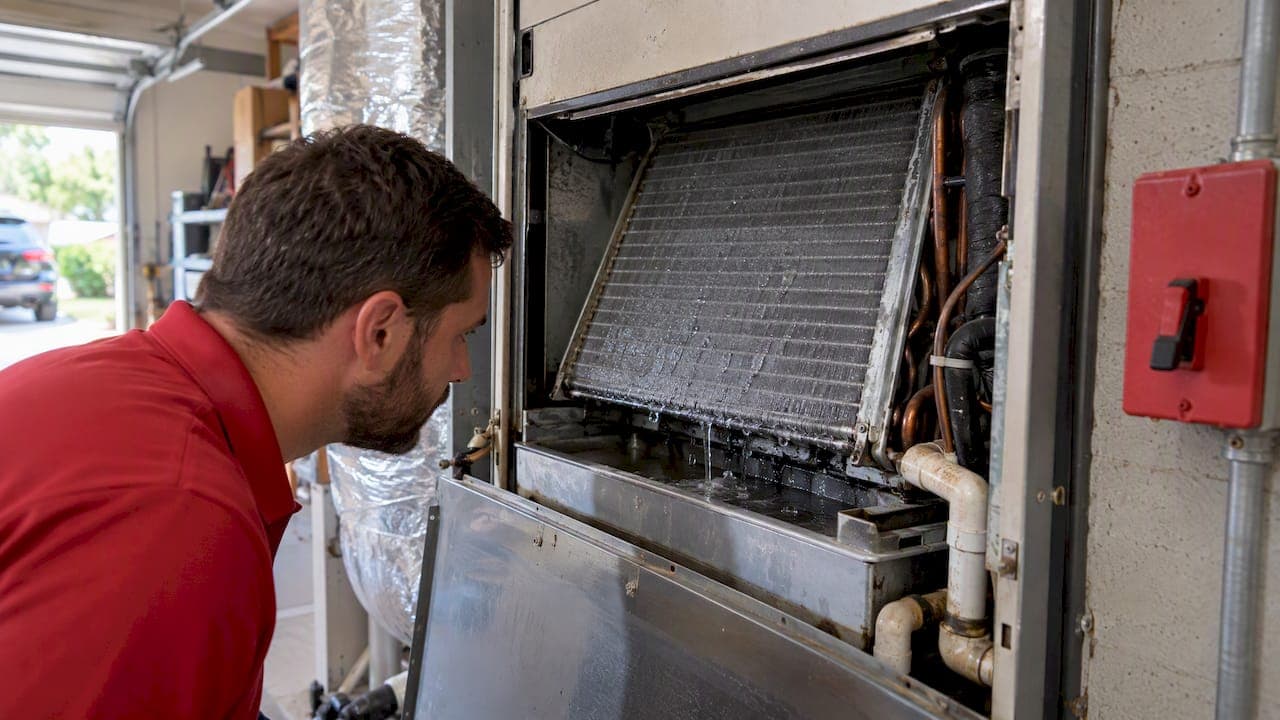
An AC does not have a humidity setting. It cools air, and water comes out as a byproduct. According to AHRI, moisture in the return air condenses when it touches the cold indoor evaporator coil, collects in a pan and drains away.
The Building America Solution Center explains the physics: dehumidification happens when the coil is colder than the dew point of the air passing over it. The system removes two kinds of heat. Sensible heat is the temperature you feel on a thermometer. Latent heat is the energy locked up in water vapor. A good humid-climate system removes both.
ASHRAE makes the key point: a conventional air conditioner dehumidifies incidentally while it cools, and it cannot control temperature and humidity independently. That is why you can hit 74 degrees on the thermostat and still feel damp. The thermostat measures temperature only. Nothing in the standard setup is watching humidity.
Why the house stays humid with the AC on
The system is too big and cycles off too soon
This is the cause I would check first, and it is the one most homeowners never hear about. The Building America guidance says humidity can stay high when a system cools the home quickly and then cycles off before it has removed enough moisture, especially in mild, humid weather. Conventional systems dehumidify best when they run for long stretches at peak load. At milder conditions they shut off quickly and take out proportionally less water.
Lawrence Berkeley National Laboratory adds that oversized equipment can make things worse, because short cycles may wet the coil without giving the condensate time to drain. This Old House lists oversizing as a common cause for the same reason: the system reaches the set point before it has run long enough to pull out moisture.
Signs of short cycling you can notice yourself:
- The AC turns on and off every few minutes instead of running in long cycles.
- Rooms cool fast but feel cold and clammy rather than dry.
- Humidity is worst on cloudy, rainy or spring and fall days, when the cooling load is light.
If you suspect sizing, ask an HVAC contractor for a load calculation. The fix may be a different system, a variable-speed unit, or adding a dehumidifier to do the job the AC cannot.
The thermostat fan is set to On
This one costs nothing to fix. ASHRAE warns that leaving the thermostat fan in the On position can blow moisture that has collected on the coil back into the house before it drains. When the compressor stops, the coil is still wet. With the fan on Auto, the air handler stops too and the water drains. With the fan on On, air keeps moving across a wet coil and carries some of that water back into your rooms.
Set the fan to Auto and watch the humidity for a day or two.
Too much or too little airflow
Airflow is a balancing act. ASHRAE notes that excessive airflow reduces dehumidification in humid climates, because air moves across the coil too fast to be cooled below its dew point. Too little airflow has its own problem: it can freeze the evaporator coil and damage the compressor. A clogged filter, closed or blocked vents, a dirty coil and a failing blower can all cause low airflow.
If you see ice on the indoor coil or refrigerant lines, turn the system off and call an HVAC technician. Do not chip the ice off.
Refrigerant charge, dirty coils and blocked drains
ASHRAE says refrigerant charge and airflow problems may require service, and that coil and drain maintenance may call for a professional. Here is what each looks like:
- Low or incorrect refrigerant charge: the coil is not cold enough to condense much water. This needs a licensed HVAC technician. It is not a homeowner repair.
- Dirty evaporator coil: a layer of dust insulates the coil and blocks airflow, so it removes less moisture.
- Blocked condensate drain: water that cannot leave backs up in the pan, overflows, or sits where it can re-evaporate. A wet pan or standing water near the air handler is also a place mold can start.
Duct leaks and outside air getting in
Lawrence Berkeley National Laboratory lists outdoor-air infiltration, exhaust-fan pressure effects, and duct or plenum leaks among the ways moisture enters a building. Leaky return ducts in an attic or crawlspace can pull in hot, wet air that the coil then has to handle. Leaky supply ducts can dump cold air into places where it condenses on surfaces.
That last case matters to me. Condensation on ductwork, vents and the ceiling around them is how a humidity problem becomes visible dark growth.
Moisture sources inside the house
The same Berkeley Lab source names cooking, washing, bathing and even the breathing of the people in the house as moisture sources. The Building America guidance adds aquariums, many houseplants and drying clothes indoors. It also notes that overventilation, a high thermostat set point, or turning off an HVAC system that has built-in dehumidification can push relative humidity up.
One more thing I see in Central Florida homes: a hidden water source. A slow supply line leak, a dripping water heater pan, a weeping shower valve or a roof leak adds moisture to a wall cavity that the AC will never keep up with. If you have done everything on the AC side and the humidity still will not drop, think about hidden water.

What you can check today
These are the steps the research supports. They take little time and cost almost nothing.
- Measure the humidity. Buy an inexpensive hygrometer and place it in the main living area and one in the room that feels worst. The Ohio State Green Home Technology Center recommends measuring both indoor and outdoor temperature and humidity, so you know whether the house is actually behind or just matching a muggy day outside.
- Change the filter. A clogged filter restricts airflow and is the cheapest thing to rule out.
- Set the fan to Auto, not On. See above.
- Check thermostat setbacks. This Old House reports that keeping the setback difference to about five degrees avoids making the system work excessively hard to recover. A big swing, such as 85 while you are at work and 72 when you come home, leaves the house humid for hours.
- Use exhaust fans. ASHRAE and Ohio State both recommend running them while cooking and showering. Vent the clothes dryer outdoors.
- Keep windows closed when it is humid outside. Opening them feels natural but lets in moisture your AC then has to remove.
- Look at the unit. With the system off, check the drain pan and drain line near the air handler for standing water, slime or rust. Look at vents and the ceiling around them for dark spots or beads of water.
Skip the coil cleaning unless you know how. ASHRAE says brushing dirt and obstructions from coils and drains helps, but that it may need a professional, and a damaged coil is an expensive mistake.
What humidity level to aim for
The Building America guidance uses example controls that start enhanced dehumidification at 55% relative humidity and supplemental dehumidification at 60%. It also says supplemental dehumidification should be considered in hot-humid climates when air conditioning cannot keep relative humidity below 60%. Those are good working numbers for a hygrometer reading in the main living space.
That gives you a simple decision rule:
| What your hygrometer shows with the AC running | What it usually means | What to do |
|---|---|---|
| Mostly below 55% | The system is doing its job | Keep up filter changes and drain checks |
| 55% to 60% | Borderline, often a short-cycling or setback issue | Fix fan and thermostat settings, watch for a week |
| Consistently above 60% | The AC alone is not keeping up | Have an HVAC contractor look at sizing, airflow and charge, and discuss a dehumidifier |
| High humidity plus musty smell or visible spots | Moisture has probably reached surfaces | Get a mold inspection |
Bridging the gap while you sort out the AC
While the system is being diagnosed, you can lower the moisture load. Use exhaust fans, vent the dryer outside, keep windows shut on humid days, and reduce air leakage around doors, attic hatches and plumbing penetrations. ASHRAE also notes that a stand-alone dehumidifier may be needed when conventional air conditioning cannot dehumidify enough. In a hot, humid climate like ours, that is not a failure. It is often just the right tool for the job.
Our perspective: when humidity is the start of a mold problem
Most people searching about humidity want their house to feel better. We look at it from the other end, after moisture has sat somewhere long enough to cause damage.
Here is what we see in Central Florida homes:
- The AC is the thing that spreads the problem. Mold in the air handler, the drain line or the ducts can send spores through the whole house. One damp spot becomes a whole-house issue when the air handler is involved.
- Cold surfaces sweat. Supply vents, ducts in the attic and ceilings below them can stay wet from condensation. A ceiling stain around a vent is usually moisture, not just dust.
- Smell often comes first. A musty smell with no visible cause usually means moisture is trapped somewhere: a wall cavity, under flooring, around a drain pan or in a closet.
- A dehumidifier does not dry a wet wall. It lowers the air’s moisture. If building materials are already wet or growing mold, the air fix is not enough.
We do not diagnose health problems and we are not HVAC technicians. If you think the AC is at fault, an HVAC contractor should fix the equipment. If you see or smell signs of mold, we can inspect it and tell you plainly what is there. If it is nothing, we will say that. If it is something, we will lay out every option, including what it costs if you pay out of pocket, before anything gets touched. And if a small patch is within your own ability to handle, we will tell you how to do it safely.
The order matters. Fix the moisture source first. Remove the mold second. Rebuild last. Cleaning mold without fixing the humidity that fed it just starts the clock again.
— John Foutz
When to call an HVAC technician, and when to call us
Call an HVAC contractor when:
- The AC short cycles, freezes up, or runs constantly without reaching the set point.
- The drain line is clogged or the pan overflows.
- You suspect low refrigerant or a dirty evaporator coil.
- Humidity stays above 60% after you have fixed the settings and filter.
- You want a sizing check or are considering a dehumidifier built into the system.
Call a licensed mold professional when:
- You see dark or fuzzy growth on a wall, ceiling, vent cover, baseboard or under carpet.
- A musty smell persists and you cannot find the source.
- Drywall or trim feels damp, soft or is stained near a vent, air handler or plumbing.
- You found mold in or near the air handler, drain pan or ductwork.
- A leak, overflow or storm let water into the house and humidity has stayed high since.
Often you need both. The HVAC contractor fixes the equipment, and we deal with what the moisture left behind. We work with plumbers, HVAC contractors and insurance agents, and there is a page for trade partners who want to know how we handle referrals.
If you find mold or water damage
If your humidity problem has already reached your walls, we start with a free mold inspection. I come out myself, I am licensed as both the assessor and the remediator, and we can add laboratory testing and air sampling when the situation calls for it. If you are in Lake Mary, here is our Lake Mary service area page.
Here is how we handle the job:
- We look first. Nothing comes out of the house until you know what is there and who is paying for it.
- You get the cash price before any claim is filed. If you have insurance, we lay out the outcomes, including the one where the insurer pays nothing. If you are uninsured, we still take the job and put the price in writing.
- You decide. Work starts only after you have made that choice.
- One company does the rest. We handle mold remediation, water damage restoration when a leak or overflow is behind it, the rebuild of drywall, tile, cabinets, counters, flooring and trim, and the insurance claim, so you are not chasing a second contractor.
You can see how we describe our services and fees on the Central Florida services page.
Common mistakes with humidity and AC
- Turning the thermostat lower to dry the house. A colder set point makes a short-cycling system cycle even more, and you end up cold and still damp.
- Running the fan on On all day for comfort. As ASHRAE notes, this can put moisture from the coil back into the air.
- Opening windows to air things out in humid weather. It brings in more water than the AC can easily remove.
- Spraying a mold spot and moving on. If the moisture source is still there, the growth tends to return.
- Ignoring a small ceiling stain near a vent. It is often the first visible sign of condensation or a leak.
- Treating only the symptom. A dehumidifier next to a wet wall hides the problem. Find the water.
FAQ
Why is my house so humid even with the AC on?
The usual reasons are an oversized system that cools the house and shuts off before it removes enough moisture, a thermostat fan stuck on On, airflow problems, a dirty coil or blocked drain, leaky ducts, and moisture sources inside the house. A conventional AC only dehumidifies as a side effect of cooling, so it works best when it runs in long cycles. Measure with a hygrometer to see how far off you are.
What humidity level should I aim for at home?
The Building America guidance uses 55% relative humidity as a point to start enhanced dehumidification and 60% as the point for supplemental dehumidification. In a hot, humid climate, if your AC cannot keep the house below 60%, it recommends considering a dehumidifier. Check readings in the rooms where you actually live, not only near the thermostat.
Can my AC make the house more humid?
Yes. If the thermostat fan is set to On, air keeps blowing over a wet coil after cooling stops and can carry water back into the house, as ASHRAE warns. An oversized system that short cycles can also leave the coil wet without letting it drain. A frozen coil from low airflow can cause its own trouble.
Is a dehumidifier the answer if my AC cannot keep up?
Often, yes. ASHRAE says a stand-alone dehumidifier may be needed when conventional air conditioning cannot dehumidify enough. It lowers moisture in the air, though, so it will not dry out a wall or ceiling that is already wet. If you smell mold or see staining, have it inspected as well.
How do I know if high humidity has caused mold?
Look for a musty smell, dark or fuzzy spots on walls, ceilings, vent covers and baseboards, and damp or stained drywall near vents or the air handler. You cannot tell by humidity alone, so a licensed assessor needs to look. We offer a free mold inspection in Central Florida.
Sources
- Air Conditioning System, AHRI
- Whole-House Dehumidification, Building America Solution Center
- Top Ten Things Consumers Should Know About Air Conditioning, ASHRAE
- Nature and Causes of Building Dampness, Indoor Air, Lawrence Berkeley National Laboratory
- How to Diagnose and Repair a Humid Air Conditioner, This Old House
- Humidity Control, Green Home Technology Center, Ohio State University