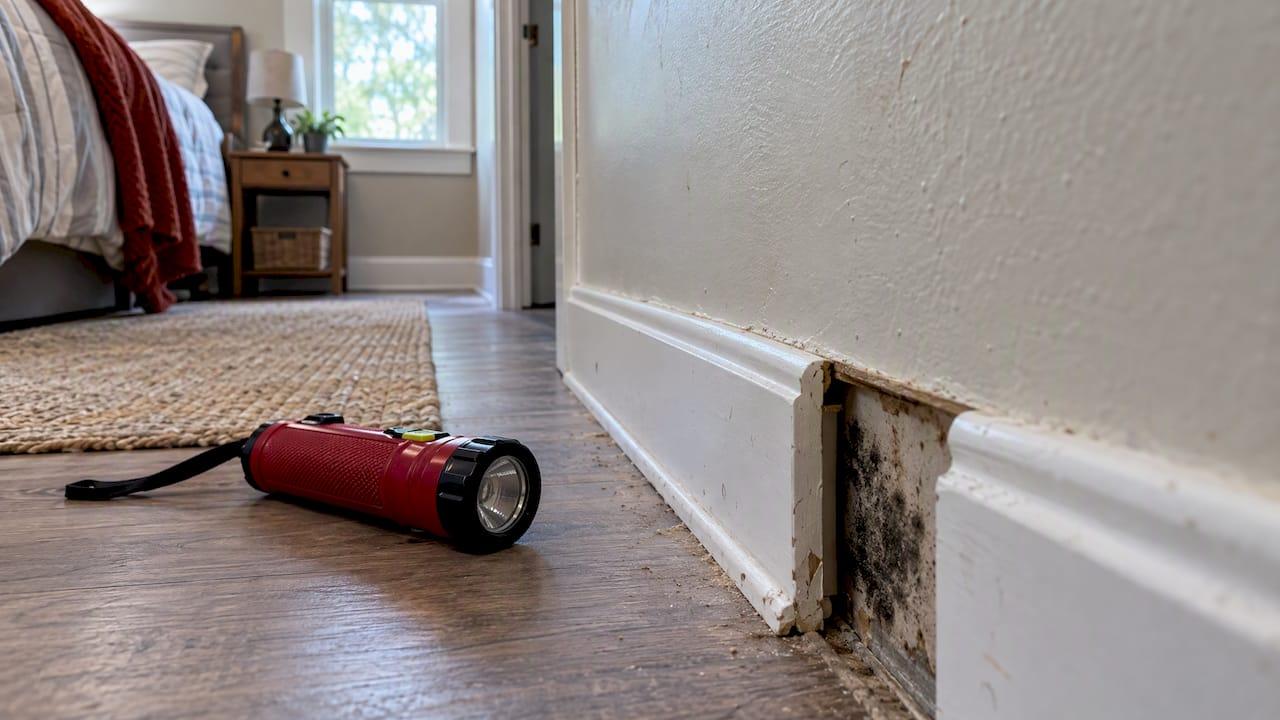
Mold Behind a Baseboard: What to Do Before You Pull It Off

If you see dark growth on a baseboard, or you smell mold along a wall and suspect it is behind the trim, treat it as a moisture problem first and a cleaning problem second. A small patch on a hard surface can be cleaned by a homeowner. Drywall that has stayed wet, growth that keeps coming back, or an area bigger than about 10 square feet needs a licensed professional. Here is how to tell which one you have, what to do in the next 48 hours, and what to ask before anyone tears anything out.
TL;DR
- Mold behind a baseboard almost always means water got into the bottom of the wall: a leak, condensation, a wet slab or floor, or constant humidity.
- The EPA says homeowners can generally handle moldy areas smaller than about 10 square feet. Larger areas, major water damage or sewage mean calling a professional.
- Wet drywall, insulation and carpet are hard to save. If they have stayed wet more than 48 hours, they usually have to be replaced, not cleaned.
- Never paint or caulk over mold, and never mix bleach with ammonia.
- Cleaning without fixing the water source only buys you a few weeks. Find the moisture first.
Table of Contents
- Why mold shows up behind baseboards
- Signs there is mold you cannot see
- What to do in the first 48 hours
- How to check behind a baseboard without spreading it
- When you can clean it yourself
- Why you should not paint or caulk over it
- When the drywall, cabinets or trim have to come out
- If the AC is part of the problem
- Our perspective
- Preventing it from coming back
- Mold behind a baseboard and your insurance
- Get a licensed look at it
- FAQ
- Sources
Why mold shows up behind baseboards
A baseboard sits at the lowest point of a wall, right where water ends up. It also covers the gap between the drywall and the floor, which is dark, still and rarely checked. That combination is what mold needs.
The EPA explains that mold grows on organic materials when moisture and oxygen are present. Paper-faced drywall, wood trim and the wood framing behind them are all food. The moisture comes from sources like leaking or condensing pipes, roof leaks, high humidity, and tightly sealed buildings with poor ventilation.
In Central Florida homes, the usual culprits behind a baseboard are:
- A slow supply line or drain leak in a bathroom, kitchen or laundry room that wicks into the bottom of the wall.
- A dishwasher, water heater or refrigerator line that has been weeping for months.
- Water entering under a window or door and running down inside the wall. If you have staining below a window, a simple hose test for window leaks can show whether the exterior is the entry point.
- Air conditioning condensation, from a clogged drain line, a sweating duct or an air handler near the wall.
- Humidity. Cold walls and warm, wet air in a closed-up house will do it with no leak at all.
- A past flood or roof leak that was dried on the surface but not inside the wall.
The EPA also notes that drywall covered with vinyl wallpaper or wood paneling can act as a vapor barrier and trap moisture underneath. The same logic applies to a tight run of trim caulked at the top and bottom.
Signs there is mold you cannot see
Sometimes the baseboard looks fine and the problem is behind it. The EPA lists the signals for hidden mold: a moldy smell, known water damage, or people in the home reporting health problems. Hidden mold can sit behind drywall, wallpaper or paneling.
In practice, here is what to look for along the bottom of a wall:
- Paint or caulk line that is bubbling, cracking or peeling.
- A baseboard that has swelled, warped, or pulled away from the wall.
- Dark spotting or staining on the top edge of the baseboard or on the wall just above it.
- A musty smell that gets stronger when the AC is off or the house has been closed up.
- A soft spot in the drywall when you press gently with a finger.
- Staining on the floor next to the wall, or flooring that is cupping or lifting.
- Carpet that feels damp or smells sour at the wall edge.
One caution on colour. Not everything dark on trim is mold. Dirt, old stains and discoloration can look similar. And you do not need to know the type of mold either. The CDC states that no matter what type is present, you need to remove it. The questions that matter are how big the area is, what material it is on, and where the water is coming from.
What to do in the first 48 hours
Speed matters because mold needs water, and water can be stopped. The EPA recommends drying wet or damp materials within 24 to 48 hours.
- Stop the water. Shut off the supply line, appliance valve or main if you can find an active leak. If it is the roof, tarp or contain what you can safely reach.
- Run the AC and a fan, and open a window if the outdoor air is drier. Your goal is to drop humidity. Keep the indoor humidity below 60%, and ideally between 30% and 50%, as the EPA advises.
- Do not tear the wall open yet. Disturbing a moldy area spreads spores through the house. The EPA points out that investigating hidden mold can be difficult and calls for caution whenever you disturb potential mold sites.
- Photograph everything. Take pictures of the stain, the baseboard, the floor and the source of the water. You will want them if there is an insurance claim.
- Do not spray bleach on it and walk away. More on that below.
- Decide which path you are on: a small, surface-level patch you can clean yourself, or wet material that needs a professional.
How to check behind a baseboard without spreading it
If you want to look, do it deliberately. The goal is a small peek, not demolition.
- Put on an N95 respirator at minimum, plus gloves and eye protection. Keep kids, pets and anyone with asthma out of the room.
- Turn off the AC or heat for the room so the air handler does not pull spores through the house. Close the door and seal the doorway with plastic sheeting and tape if you have it.
- Score the paint or caulk line along the top of the baseboard with a utility knife, then pry gently. Pull it off in one piece if you can.
- Look at the back of the baseboard and the bottom of the drywall. Note what you see, how far it extends, and whether the drywall is dark, soft, swollen or crumbling.
- Put the baseboard in a trash bag if it is moldy. Do not carry it through the house uncovered.
Measure the affected area before you decide what to do. The EPA’s remediation guidance sorts jobs by size: small is under 10 square feet, medium is 10 to 100 square feet, and large is over 100 square feet, or any job where the potential for exposure is significant. Larger jobs call for containment, meaning plastic barriers and controlled airflow so the work does not contaminate the rest of the house.
A note on testing. The CDC does not recommend home mold testing because health effects vary by person and there are no standards for acceptable mold levels. A test does not tell you whether you should remove visible mold. A good inspection answers the more useful questions: where the moisture is, how far the material is affected, and what has to come out. Our free mold inspection is built around those questions, and laboratory testing and air sampling are available when a situation calls for them.
When you can clean it yourself
A small patch on a hard, non-porous or sealed surface, such as painted wood trim or tile, with no soft drywall behind it, is a reasonable homeowner job. The EPA says homeowners can generally handle areas under about 10 square feet. We would add some stop-thresholds of our own:
- The drywall behind the baseboard is soft, swollen, crumbling or stained all the way through.
- The growth is on the back of the drywall, not just the face of the trim.
- You find more behind the first patch than you expected.
- Anyone in the house has asthma, allergies, a weakened immune system or a respiratory condition.
- The water came from sewage or other contaminated water. The EPA says to call a professional for those.
- You cannot find or fix the moisture source.
If you pass all of those checks, here is how to do it.
Step-by-step cleaning of a small area
- Set up as above: respirator, gloves, goggles, room closed off, HVAC off.
- Mist the surface lightly with water first so dry spores do not become airborne.
- Scrub with soap and water and a stiff brush or cloth. The CDC says mold can be removed from hard surfaces with household products, soap and water, or a bleach solution.
- Wipe with clean damp rags, then dry the area completely. A fan and dehumidifier help.
- Bag the rags, the sponge and anything porous you removed. Seal the bag before it leaves the room.
- Leave the baseboard off for a day or two so the wall cavity can dry, and check the back of the drywall again before reinstalling.
The EPA says that routine use of biocides such as chlorine bleach is not recommended, though a professional may use it in specific cases. If you do use a bleach solution, never mix it with ammonia or with cleaners that contain ammonia. The EPA warns it can produce toxic fumes, and the CDC calls the result poisonous gas. Ventilate the room and use nothing stronger than you need.
If a respirator is part of your plan, note that P100 cartridges on a half-face or full-face mask do not remove vapors or gases. The EPA describes this limited protection as something that may be warranted for areas of 10 to 100 square feet, which is already past the point where we would hand most homeowners a scrub brush.
Why you should not paint or caulk over it
It is tempting to caulk the gap, put the baseboard back and repaint. Do not. The EPA says not to paint or caulk moldy surfaces. Clean and dry them first, because paint over a moldy surface is likely to peel.
The same goes for spray-on coatings and sealers sold as a fix. A coating does not take away the moisture, and as long as the wall is wet underneath, the growth has the food and water it needs. If someone quotes you a spray-only or encapsulation job without telling you where the water came from and whether the drywall is wet, ask them to explain that first.
When the drywall, cabinets or trim have to come out
Porous materials such as drywall, carpet and insulation are hard to clean because mold can get into them. The EPA says that if they have been wet for over 48 hours, they should generally be removed and replaced.
There is one useful exception. According to the EPA, drywall may be dried in place if there is no obvious swelling and the seams are intact. Otherwise, it is removed, discarded and replaced.
That is why a baseboard job sometimes turns into a wall job. Here is what a licensed crew usually does:
- Finds and confirms the water source, with moisture readings, before anything is removed.
- Sets up containment so the work does not spread through the house.
- Removes the baseboard and the affected drywall. Often that means cutting the wall open higher than the visible damage, to get past the growth on the back side.
- Cleans the exposed wood framing and lets it dry.
- Confirms the cavity is dry before closing it.
- Rebuilds: new drywall, tape, texture, paint, trim and any flooring or cabinet work that had to come out.
Mold behind cabinets works the same way, with one extra step. Toe-kicks and cabinet bases often have to come off or be cut away to reach the wall, and a cabinet that sat in moisture may be too far gone to save. Mold behind other trim, such as door casings and window returns, follows the baseboard pattern: find the leak, open what is wet, replace what cannot be cleaned.
If the AC is part of the problem
In Florida, a wall that stays damp is often not a plumbing issue at all. A drain line that backs up, a duct that sweats in an attic or closet, or an air handler sitting against a wall can feed water to the same baseboard for months. If the mold keeps returning on one wall, or you smell it when the air comes on, have the HVAC system checked. Fixing moisture first when mold is in the ducts is the same principle that applies to the wall: removing the growth does not last if the source of water is still there.
Health is the other reason to take it seriously. The CDC says exposure to damp and moldy environments may cause coughing or wheezing, and people with asthma or mold allergies may have severe reactions. Health effects vary, and some people have none. If someone in your home has persistent symptoms, talk to their doctor. We do not diagnose, and a mold inspection cannot tell you whether the house is the cause of an illness. Our page on mold exposure symptoms and warning signs explains how we think about that line.
Our perspective
Most of the baseboard calls we get start the same way. A homeowner pulls off a piece of trim, finds a dark stain, and then spends a week wondering what happens next: who pays, who does the work, and whether the wall is going to come out.
We run the job in a specific order. First we find the water and measure what is wet. Then we tell you what the work costs in cash, what the insurance claim could look like, and what happens if insurance pays nothing. Nothing comes out of your house until you know who is paying for it and you have decided to go ahead.
We hold Florida licenses as both a mold assessor and a mold remediator, and we are licensed for the reconstruction too. The same company that opens the wall closes it, so you do not end up with a tear-out crew that leaves and a contractor you have never met. We also handle the insurance claim from start to finish.
If you want to clean a small patch yourself, we will give you the instructions in detail, and we will tell you honestly when the size or the wet drywall means you should stop. You deal with me directly. I answer the phone and I come out to look at it myself.
John Foutz
Preventing it from coming back
The EPA’s guidance boils down to this: the key to mold control is moisture control. If mold is present, clean it up promptly and fix the water problem so it does not return.
For baseboards and lower walls, that means:
- Keep indoor humidity below 60%, ideally 30% to 50%. A cheap hygrometer tells you where you are.
- Run bathroom fans during and after showers, or open a window.
- Fix leaks as soon as you find them, including slow ones at toilets, under sinks and behind appliances.
- Dry anything that gets wet within 24 to 48 hours.
- Keep furniture a couple of inches off exterior walls so air can move.
- Keep the AC drain line clear and have the system serviced regularly.
- Check along baseboards after heavy rain or an appliance repair.
If you are closing up a second home or a vacant property, humidity is the thing to watch. A basic hygrometer in an empty house is a simple way to catch a rise before it turns into growth on the walls.
Mold behind a baseboard and your insurance
Most homeowners worry about the bill more than the mold. Coverage depends on your policy and on what caused the water. Sudden, accidental events are treated very differently from long-term seepage or humidity in many policies, so read yours or ask your agent before you assume anything either way.
What helps in every case: document before you disturb, keep the damaged materials if you can, and do not let anyone start demolition until the payment question is answered. That sequence is exactly how we work. We lay out every outcome, including the one where the claim is denied or pays nothing, and you decide how to proceed with the cash price in front of you. If you have no insurance or do not want to file, we take the job on a cash basis with the price in writing first.

Get a licensed look at it
If you have found mold behind a baseboard in Lake Mary, Seminole County or the surrounding Central Florida cities we serve, the next step is simple: have it looked at before the wall gets opened. We offer a free mold inspection, and if the work goes beyond a small patch, our mold remediation covers the cleanup and the rebuild under one licensed company. If the cause is a fresh leak, see our water damage restoration service, because drying the wall quickly is what keeps a wet cavity from becoming a mold job.

You can reach John directly through Ready 2 Inspect in Lake Mary. Tell him what you see, where it is and when the water last got in.
FAQ
Is mold behind a baseboard dangerous?
It can be, depending on the amount and who lives in the home. The CDC says damp, moldy environments may cause coughing or wheezing, and people with asthma or mold allergies can react severely. Effects vary, and some people notice nothing. If anyone has ongoing symptoms, see their doctor and deal with the moisture source quickly.
Can I just remove the baseboard and clean the mold?
If the growth is on a hard surface, covers under about 10 square feet and the drywall behind it is firm and dry, yes. Use soap and water, protect yourself, and dry the area fully. If the drywall is soft, swollen or stained through, it has likely absorbed the mold and needs to be replaced.
Should I paint or caulk over mold on trim?
No. The EPA advises against painting or caulking moldy surfaces. Clean and dry the surface first, because paint over mold tends to peel and the growth keeps going underneath. Fixing the moisture source is what stops it from returning.
How do I know if there is mold behind drywall?
Look for a musty smell, a history of water damage, peeling paint, soft or discolored drywall, and anyone in the home reporting symptoms. The EPA suggests hiring an experienced professional if you suspect hidden mold, since checking can spread contamination when it is done carelessly.
Do I need a mold test first?
Not to decide whether to remove visible mold. The CDC does not recommend home mold testing because there are no standards for acceptable levels. A professional inspection that finds the moisture source and the extent of wet material is more useful.
Sources
- EPA: A Brief Guide to Mold, Moisture and Your Home
- EPA: Mold Course Chapter 2
- EPA: Mold Course Chapter 6
- EPA: Mold Remediation in Schools and Commercial Buildings
- EPA: A Brief Guide to Mold, Moisture, and Your Home (2012)
- EPA: Mold Worker and Employer Guide
- EPA: Mold Web Course
- CDC: Mold
- CDC: You Can Control Mold
- Stop mold in air ducts by fixing moisture first
- Water damage under a window: start with a hose test
- Stop mold in a vacant house with a hygrometer