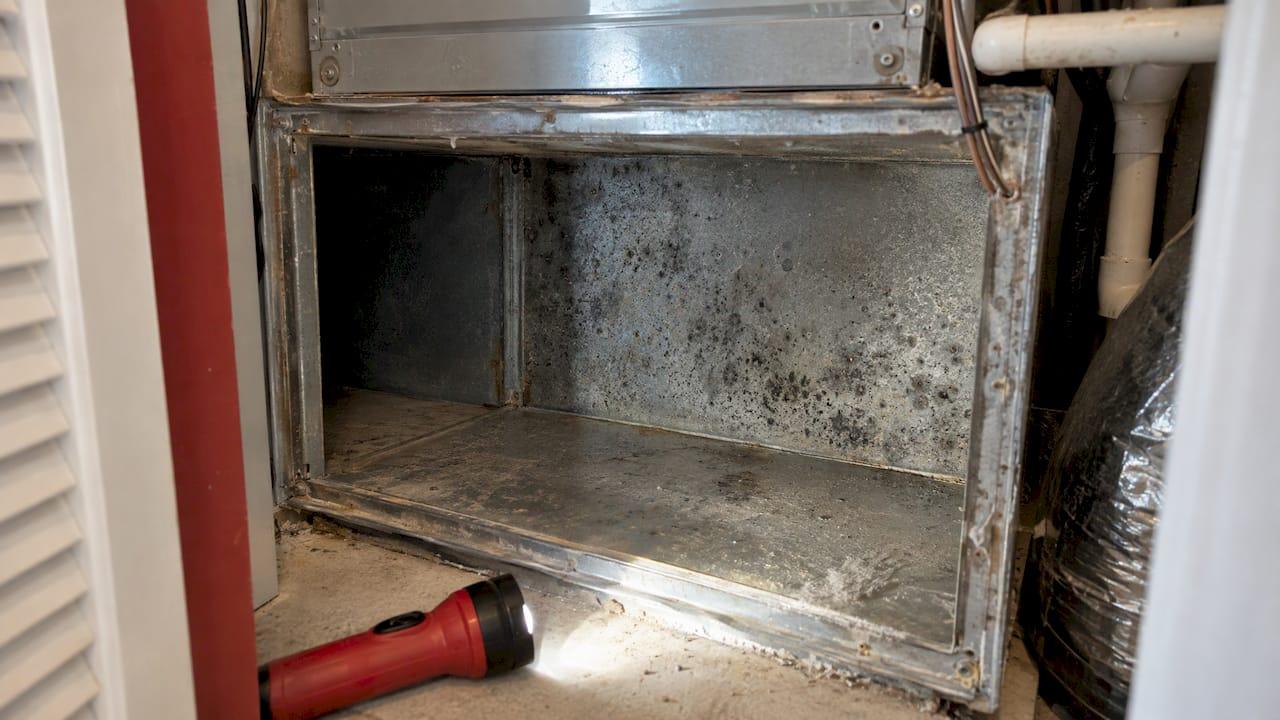
Mold in Air Ducts: How to Spot It, Clean It and Stop It Coming Back

If you can see fuzzy or dark growth on a vent cover or on bare sheet metal just inside a duct, you can usually clean a small patch yourself. Mold on insulated or flexible duct, in the air handler or at the drain pan is a different job. In Central Florida, where the AC runs most of the year, the real fix is always the same: find the moisture, dry it out, and remove the contamination instead of covering it. I’m John Foutz, a Florida-licensed mold assessor and remediator, and this is how I walk homeowners through it.
TL;DR
- Small spots on vent covers or smooth metal duct can be cleaned by a healthy homeowner with the system off and proper protection.
- Mold on insulated or flex duct, in the air handler, on the coil or at the drain pan needs a licensed professional. Wet or moldy duct insulation usually has to be replaced, not cleaned.
- Never rely on a spray, sealant or paint to hide it. If the moisture source stays, the mold comes back.
- Dark dust at a register is not always mold. Confirm before you spend money.
- Our mold inspection is free, and you get every outcome and the price in writing before any work starts.
Table of Contents
- How to tell whether it is mold in your ducts
- Why Central Florida ducts grow mold
- What you can clean yourself
- Why sprays, sealants and paint do not solve it
- When ducts need replacing
- What professional remediation involves
- What it costs
- Is duct cleaning worth it for health reasons?
- Keeping mold out of your ducts
- Get a licensed look at your system
- FAQ
- Sources
How to tell whether it is mold in your ducts
Start with what you can see and smell. Pull a supply register cover off and look inside with a flashlight. Look at the cover itself, the boot behind it, and the first foot or two of duct. Then check the return grille and the filter, and look at the area around the air handler for staining or a damp smell.
The signs we see most often:
- A musty or earthy smell that gets stronger when the AC kicks on.
- Black, gray or green fuzzy or speckled growth on a register, a duct wall or the insulation.
- Dust that keeps coming back thick and dark around vents.
- Water stains, rust or dripping near the air handler, the drain line or the ceiling below a duct run.
- Family symptoms that worsen while the system runs and ease when you leave the house.
That last one is a clue, not a diagnosis. The CDC notes that mold exposure can cause allergic reactions and asthma, and that there is enough evidence linking it to upper respiratory symptoms like coughing and wheezing in otherwise healthy people. It does not say your house is the cause of any one person’s symptoms, and neither can I. For what symptoms can and cannot tell you, read our page on mold exposure symptoms and warning signs, and talk to your doctor about anything that is persistent or getting worse.
Is it really mold?
Black residue at a vent is often just dust, soot from candles, or debris. The EPA says that a positive determination of whether a substance is mold can be made only by an expert and may require laboratory analysis. It also notes that some microbiology laboratories can tell you for about $50 whether a sample lifted on clear sticky tape is mold or something that merely looks like it. Parts of the system also cannot be reached for a visual check, so a visual look alone can miss growth.
That is why we offer a free mold inspection with laboratory testing and air sampling. A licensed assessor looks at the duct, the air handler and the surrounding structure, and tells you what is growing, where, and why.
Why Central Florida ducts grow mold
Mold needs moisture, a food source and time. Duct dust and fiberglass lining supply the food. Our climate supplies the moisture.
Cold air moving through ducts in a humid house meets warm, damp air outside the metal, and condensation forms. The EPA’s training material on indoor air quality points out that moisture control is the most effective way to prevent biological growth in ducts, and that condensation near the cooling coil is a major factor in moisture contamination of the system.
In our service area, from Lake Mary and Longwood to Winter Park, Deltona and Orange City, the usual causes are:
- A clogged or poorly sloped condensate drain line that backs up into the pan.
- Duct runs in a hot attic with torn insulation, loose connections or gaps, so humid air condenses on the outside of the duct.
- A roof leak that soaks duct insulation. Water coming through a roof is a duct problem too, and guides on attic water damage repair show how far a small leak can spread before anyone sees it.
- An oversized AC unit that cools fast and shuts off before it dehumidifies.
- A recent water loss, such as a supply line or water heater leak, that was never dried properly.
This is the pattern we see: one wet wall or ceiling, and then the AC distributes spores through the rest of the house. That is why a duct problem and a wall problem are often the same job.
What you can clean yourself
If you are going to do it yourself, I will give you the instructions in detail. The limit is the surface and the size of the problem, plus your own health.
Do not do this yourself if anyone doing the work has allergies, a weakened immune system, asthma, COPD or other chronic lung disease. Have someone else do it or call us.
Small patches on vent covers and smooth metal duct
- Turn the system off at the thermostat and the breaker. A running blower will push spores everywhere.
- Put on an N95 respirator at minimum, non-latex gloves and goggles that fully protect your eyes. This matches what the CDC recommends for mold cleanup.
- Remove the register or grille and carry it outside or to a tub. Wash it with dish soap and warm water and scrub off the growth.
- Wipe the accessible bare sheet metal just inside the opening with a cloth dampened with soap and water. Do not spray inside the duct.
- Dry everything completely before it goes back. A damp duct invites regrowth.
- Put in a fresh filter, and then watch the spot over the next few weeks.
If you use bleach on a hard surface such as a removed cover, the CDC says to use no more than 1 cup per gallon of water, and never to mix bleach with ammonia or any other cleaner. Dish detergent works fine for most of this, and I prefer it.
Stop and call a professional if
- The growth is on insulated duct, duct board or flex duct.
- It is on the air handler, the coil or the condensate pan.
- It keeps coming back within weeks of cleaning. That means the moisture source is still there.
- You find it across more than a small area, or in several rooms.
- Water is visibly entering the system.
- You or someone in the home has symptoms, or is in a higher-risk group.
The EPA says insulated ducts that get wet or moldy cannot be cleaned effectively and should be removed and replaced. Its guidance on duct cleaning also says to consider cleaning when there is substantial visible mold growth inside hard-surface ducts or on other components of the system.
Why sprays, sealants and paint do not solve it
We get this call a lot: someone was quoted a spray-on fix, a fogging treatment or an encapsulant coating, and wants to know if it will hold.
The industry standard says no to coating as a substitute for removal. The 2025 NADCA standard prohibits using sealants or encapsulants in place of physically removing contamination, and allows surface treatments only after the system has been cleaned and passed a cleanliness check. The EPA adds that no chemical biocides are currently registered for use in internally insulated duct systems, and that research has not shown that biocides or sealants work in duct cleaning.
In plain terms: mold that is painted or sealed over is still there, and it can still feed on whatever moisture reaches it. Remove it, dry it, fix the cause, and only then consider any finish.
When ducts need replacing
Replacement is not an upsell when the material cannot be cleaned. Two rules cover most cases:
- The NADCA standard says porous materials with microbial growth should be properly removed and replaced. Fiberglass-lined duct and duct board fall in this group.
- The same standard recommends replacement when fiberglass material is damaged, deteriorated or breaking down so that cleaning or coating cannot restore it.
Sheet metal duct is the opposite case. Hard surfaces can be cleaned and dried, which is why the EPA is comfortable with cleaning them when mold is visible.
The NADCA standard also requires mold remediation inside a system to follow the ANSI/IICRC S520 standard. Ask whoever works on your system to tell you which standard they follow.
What professional remediation involves
A proper job treats the whole HVAC system, not one register. The EPA warns that failing to clean one component of a contaminated system can re-contaminate the whole system and cancel the benefit. It also advises making sure the provider agrees to clean all components and is qualified to do so.
Our sequence on a mold job that involves the AC looks like this:
- Inspection and sampling. We confirm what is growing and where, using lab testing and air sampling where it helps.
- Moisture source. We trace where the water is coming from, whether that is the drain line, the attic, a leak or humidity, because nothing else holds without it.
- Written scope and price. You get every outcome in writing, including the one where your insurance pays nothing, before anything comes out.
- Containment and removal. Affected material is removed under containment, so spores are not pushed into the rest of the house.
- Drying and verification. The area is dried and rechecked.
- Rebuild. We are licensed for the reconstruction too: drywall, trim, flooring, cabinets and more. The company that opens the wall is the one that closes it.
The mold remediation we do is described on our mold remediation page.
What it costs
We do not publish a flat price, because ducts vary too much, and we put a written number in front of you before work starts. For general context, Bob Vila’s 2026 national averages show how wide the range is:
| Job | Typical national cost |
|---|---|
| Professional mold removal, average range | $1,125 to $3,439 |
| Air duct cleaning added to a mold job | $100 to $400 |
| Duct cleaning limited to contaminated ducts | $600 to $2,000 |
| Whole central AC system mold remediation | $2,000 to $10,000 |
| Duct cleaning with antimicrobial treatment, 1,500 to 2,500 sq ft home | $500 to $1,200 |
| Full duct replacement, typical home with flex duct | $3,500 to $8,000 |
Those figures come from Bob Vila’s 2025 mold cost guide and are national, not Florida, numbers. What moves the price most is how far the growth has spread, whether insulation or flex duct must be replaced, and whether drywall or ceilings are also affected.
A point on insurance: coverage for mold depends on your policy and what caused the water. Some policies cover a sudden, accidental water loss and its resulting mold, and others limit or exclude mold. We manage the claim end to end, and we tell you the cash price up front so you know where you stand either way.

Is duct cleaning worth it for health reasons?
Honestly, it depends on what is in the duct. UGA Extension summarizes a review of 48 studies that found duct cleaning does not prevent health problems, and notes the EPA does not recommend it as a routine practice. The same page says visible mold on the sheet metal inside ducts or on other heating and cooling components could justify it.
So routine, whole-house “duct cleaning specials” are one thing, and removing known mold contamination is another. We deal with the second.
On symptoms, Cleveland Clinic’s Dr. Ibrahim says people respond to mold very differently depending on overall health, immune strength and allergies, and that mold-related breathing problems are usually temporary and fade with less exposure. If you have asthma or another lung condition, see your doctor about symptoms rather than trying to work out the cause on your own.
One more thing for hiring anyone: Wirecutter reports that duct cleaning is largely unregulated, without the apprenticeship and licensing requirements plumbers, electricians and HVAC technicians face. In Florida, mold assessment and mold remediation are licensed trades, so ask for the license numbers and look them up. Mine are MRSA4802 (assessor) and MRSR4767 (remediator).

Keeping mold out of your ducts
Prevention is mostly moisture control:
- Fix leaks fast. Roof, plumbing and appliance leaks that wet duct insulation should be dried right away.
- Keep the condensate line clear. Make sure the pan drains properly, and pay attention to the cooling coil.
- Seal and insulate ducts in non-conditioned spaces like the attic so they do not sweat.
- Use the highest-efficiency filter your equipment manufacturer recommends, and change it regularly. UGA Extension gives the same advice.
- Control humidity. The EPA manual says to keep humidity below 55%, ideally 30% to 50%. A cheap hygrometer tells you where you stand.
- Cover registers during construction and vacuum with a HEPA cleaner, so dust does not build up in the system.
The EPA is blunt about the rest: if the conditions that caused growth are not corrected, it will come back.
Our perspective
Most people who call about mold in the ducts are not really asking about ducts. They are asking who is going to pay, what it will cost, and whether the same problem will be back in six months.
That is why we work in a set order. We find the moisture first, confirm what the growth actually is, and tell you the cash price and every possible outcome, including insurance paying nothing, before anything comes out of the house. Work starts when you decide.
I answer the phone and I come out myself. You are not handed to a dispatcher or a crew you have never met. When the mold has gotten into drywall, trim or flooring, the same licensed company rebuilds it and runs the claim, so nobody is left holding a half-finished job.
If you want to handle a small patch on a vent cover yourself, do it with the steps above. If it is on insulation, at the air handler, or it has come back once, call me.
John Foutz
Get a licensed look at your system
If you have found growth in a duct, a musty smell tied to the AC, or a wet area near the air handler, we can come out and assess it. Our free mold inspection covers laboratory testing and air sampling. If the mold has spread into the structure, our mold remediation service and in-house reconstruction handle the cleanup and the rebuild, and we manage the insurance claim along the way.

We serve twenty-five cities across Seminole, Orange, Volusia and Lake counties. Start with the page for your city, such as Lake Mary, or call John directly through ready2inspect.com.
FAQ
Can I clean mold out of air ducts myself?
Only small patches on vent covers or smooth metal duct, and only if nobody doing the work has asthma, allergies or a weakened immune system. Turn off the system, wear an N95, gloves and goggles, wash with dish soap and water, and dry everything fully. Mold on insulated or flex duct or at the air handler needs a licensed professional.
Does duct cleaning get rid of mold?
Cleaning can remove mold from hard sheet metal surfaces when the whole system is cleaned and the moisture problem is fixed. The EPA says wet or moldy insulated duct cannot be cleaned effectively and should be replaced. If the moisture source stays, the mold will recur.
Is mold in my air ducts making me sick?
Mold can cause allergic reactions and respiratory symptoms, but symptoms alone cannot tell you the ducts are the cause. A clue is symptoms that worsen when the system runs and ease when you are away. See your doctor about symptoms, and have the home assessed to find out what is in it.
How much does it cost to remove mold from air ducts?
National 2026 averages range from about $600 to $2,000 when contamination is limited to the ducts, and up to $10,000 for a whole central AC system. Replacing the ducts runs about $3,500 to $8,000 nationally. We give you a written price before any work starts.
Can I just spray or seal the mold in my ducts?
No. Industry standards prohibit sealants and encapsulants in place of removal, and the EPA has no registered biocides for insulated duct systems. Coating over mold leaves it in place.
Sources
- Should You Have the Air Ducts in Your Home Cleaned? (US EPA)
- US EPA, duct cleaning archived page on biocides
- Indoor Air Quality and Mold Remediation Service Techniques
- Mold Clean Up Guidelines and Recommendations (CDC)
- The NADCA Standard ACR, 2025 Edition
- Mold in HVAC Air Ducts: Causes, Signs, and Removal Tips (Bob Vila)
- HVAC filters, duct cleaning, and indoor air quality (UGA Extension)
- What Happens if You Breathe in Mold? (Cleveland Clinic)
- Is Duct Cleaning Kind of a Scam? (Wirecutter)
- Attic Water Damage Repair: Steps, Costs and Prevention