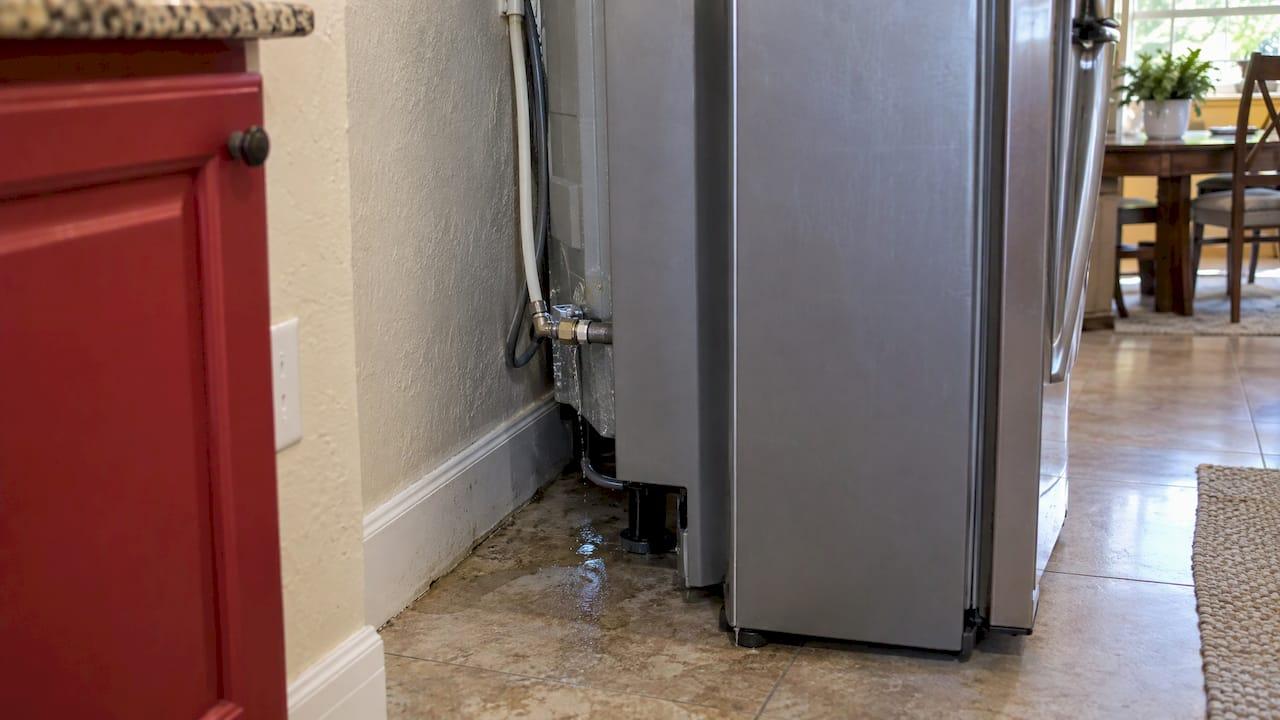
Refrigerator Water Leak: Find the Source and Protect Your Floor

Water around your refrigerator almost always comes from one of four places: the water supply line, the defrost drain, the drain pan, or a door that is not sealing. Where the water shows up tells you most of what you need to know. Shut off the supply first, find the source second, and dry the floor and the cabinet edges completely, because the leak you can fix in an afternoon is not the one that causes the expensive damage. The one that does is the slow leak that soaks the subfloor and the wall behind the fridge.
I’m John Foutz. I restore water-damaged homes across Central Florida, and I see what a small refrigerator leak turns into when it runs for weeks behind a unit nobody moved. Below is how to find the source, what you can safely fix yourself, and when the leak has become a restoration job.
TL;DR
- Unplug the fridge and turn off its water supply before you start tracing the leak, then pull the unit out from the wall.
- Water at the back usually points to the water valve or supply line. Water at the front or bottom usually points to a blocked defrost drain, a cracked drain pan or a door problem.
- A copper supply line leak or a stuck water valve is a plumber’s or technician’s job, not a tightening job.
- Dry the floor, baseboards and cabinet sides fully. If the floor is soft, the baseboard is stained or there is a musty smell, the water has gone past the appliance.
- In Florida’s humidity, wet materials that stay damp can turn into a mold problem, so a leak that has run for a while deserves a proper look.
Table of Contents
- What to do in the first ten minutes
- Where the water is tells you the cause
- Water line and ice maker line leaks
- Water under the fridge with no obvious line
- Safe fixes you can try, and where to stop
- When a fridge leak becomes a water damage job
- Does homeowners insurance cover a refrigerator leak?
- Get the floor and the wall behind the fridge checked
- FAQ
- Sources
What to do in the first ten minutes
This part is about limiting how much water gets out. You do not need to know the cause yet.
- Stop the water. If the fridge feeds an ice maker or dispenser, turn the ice maker off first. Then pull the refrigerator out carefully, find the water connection at the back, follow the copper line to the house supply and turn the shut-off valve clockwise. If there is a saddle valve on the home supply line, LG says to turn it off to stop a leaking line until a technician can correct it.
- Unplug the fridge. You will be working around wet floors and a powered appliance. Whirlpool’s supply line check also starts with unplugging it for safety. Move food to a cooler.
- Mop up and move the water away. Use towels, then a wet vacuum if you have one. Water that pools along a wall wicks into baseboards and drywall faster than most people expect.
- Note where the water is. Front, back, under the center, inside the cabinet. Take a photo. You will want it for the repair tech and, if the water spread, for your insurance company.
- Pull the fridge fully out and look behind and beneath it. A flashlight and a dry paper towel are the tools here. You are looking for a wet line, a wet fitting, a wet floor trail leading back to one point.
If the water is spreading across the kitchen, coming from a pipe in the wall, or you cannot find a shut-off, close the main water valve to the house.
Where the water is tells you the cause
Manufacturers sort fridge leaks by location, and so should you. Amana notes that leaks typically come down to drainage, door sealing or water supply components, so those are the places to start.
| Where you see water | Most likely cause | What you can do | When to call someone |
|---|---|---|---|
| Back of the fridge, near the wall | Damaged water valve or water line | Check connections and tighten if loose | Holes, cracks, or a leaking copper line |
| Front of the fridge | Blocked defrost drain line | Thaw the line with hot water | Repeated blockage |
| Bottom center, under the unit | Cracked or misplaced drain pan, or heavy humidity | Check the pan position | Cracked pan: have a technician handle it |
| Inside the fridge, under the crisper drawers | Blocked interior drain | Flush with hot water or clear it with a mini plumber’s snake | If it keeps coming back |
| Dripping at the filter head | Wrong, overdue or badly seated filter | Reseat or replace with the correct filter | Drips continue after a correct install |
| Pooling after the door was left open | Frost buildup, then melt | Close the door and let it recover | Leak continues |
The locations above come from GE Appliances’ leak guide, plus the filter and door notes from Amana and Frigidaire.
Water line and ice maker line leaks
If the fridge has an ice maker or water dispenser, the supply plumbing is the first thing to rule out. GE points out that leaks from the back typically mean a damaged water valve or water line, and that supply plumbing is the likely suspect when the fridge is connected to a water supply.
Here is how to check it.
- With the fridge pulled out and the water off, dry every connection with a paper towel. Frigidaire’s method is to wipe the lines, connections and valve dry, then see which one is wet again.
- Check the connection at the back of the fridge. On many LG units, look at where the line enters the fitting. If two black lines are visible instead of one partially visible line, press the collet and push the line in until only one shows.
- Look along the line for cracks, splits or kinks. LG says damage along the back means the unit needs repair service. Whirlpool notes that a kink can reduce water flow, which is a sign the line is stressed.
- Check the water valve itself. GE says it may be leaking or flooding, possibly stuck on. If so, schedule a service appointment.
One split worth knowing: GE says that if the leak is coming from the copper line, contact a local plumber. If the plastic fill line from the valve to the ice maker is loose or split, shut the water off and tighten the valve.
The slow version of this leak is the one I worry about. A weeping fitting behind the fridge might drip a few ounces a day. No puddle ever reaches the front. The water goes into the floor edge, the baseboard and the bottom of the wall, and nobody sees it until a floor tile lifts or the smell starts.
Water under the fridge with no obvious line
Some fridges have no water line at all, and the water still shows up. Then it is almost always the defrost system.
A self-defrosting fridge melts frost off the evaporator, and the melt water runs down a drain tube into a pan at the bottom, where it evaporates. Two things break that chain.
A clogged drain. GE says water at the front is often a blocked drain line. The fix is to remove the tube and run it under hot water to thaw the ice blocking it. Water inside the fridge near the crisper drawers can mean the interior drain line is blocked. Hot water or a mini plumber’s snake can clear it, and GE says to get expert help if it keeps happening. If ice builds up on the freezer floor or under the vegetable pans, GE says that usually needs a service call on most models.

A cracked or misplaced drain pan. Water from the bottom center can come from a cracked or poorly positioned pan, or from heavy humidity, and GE says pan problems are often best left to professionals.
Two simpler causes are easy to miss:
- A door left ajar. Frigidaire says an open door lets in air that can ice up the evaporator and cause water to leak from the bottom. Closing the door should bring things back to normal. A worn gasket can do the same slowly.
- A bad filter. Amana says incorrect or overdue filters can cause drips at the filter head. Use the right filter, seat it fully, lock it as directed and check for moisture around the cap.
If you are comparing refrigerator leaks to other kitchen appliance leaks, the same “follow the wet trail to the highest wet point” method applies. This breakdown of a dishwasher leaking under the sink shows how location narrows the cause.
Humid Florida kitchens add one more variable. A fridge in a hot garage or an enclosed utility space sweats on its exterior, and the floor can look like a leak when it is condensation. If your unit sits in a garage, this page on a sweating garage floor explains why concrete floors collect moisture in humid weather, which helps you tell condensation from an actual leak.
Safe fixes you can try, and where to stop
I will give you the do-it-yourself steps. Most homeowners can handle a drain thaw and a filter reseat.
Thawing the defrost drain
- Unplug the fridge.
- Empty the freezer and remove the panel at the back of the freezer compartment to reach the drain.
- Melt any ice in the drain area with warm water.
- Clear the top of the drain tube with a pipe cleaner or a straw if it is packed.
- Pour warm water down the tube to confirm it drains, then reinstall the panel and plug the fridge back in.
Those steps follow the method Sears Home Services describes. Check your owner’s manual first, because panel layout differs by brand.
Reseating a water line. Only if the line is intact and the water is off. Push it fully into the fitting as the manufacturer shows. Do not use tape or sealant on a compression fitting to patch a leak.
Stop and call a pro in these cases:
- The copper supply line is leaking, or the valve is stuck on.
- The drain freezes up again after you cleared it. A technician may need to fit a defrost drain heater, according to Sears.
- The pan is cracked.
- You cannot find the source. Whirlpool says to consult the manual and then call a technician if the fridge still leaks after troubleshooting.
An appliance technician fixes the fridge. A plumber fixes the supply line. Neither of them dries your floor.
When a fridge leak becomes a water damage job
Fixing the leak is half the job. The other half is what the water did while it ran.
Signs the water has gone past the appliance:
- Flooring that cups, buckles, lifts or feels soft under foot.
- Baseboards that are swollen, stained or pulling away from the wall.
- Cabinet sides or toe kicks that are discolored or crumbling.
- A musty smell near the fridge that does not go away after you dry the surface.
- Dark spots on the wall behind the unit or along the bottom of the drywall.
- A leak you suspect ran for days or weeks before you saw it.
Surface drying with towels does not dry a wet subfloor or a wet wall cavity. In a Central Florida house with the AC cycling and outdoor humidity high, damp materials stay damp. Hidden moisture is how a one-appliance leak becomes a mold job. If you want to know what mold looks like and what exposure can mean, our page on mold exposure symptoms and warning signs covers it in plain terms, with no diagnosing.
The order I follow matters, and it protects you from surprises:
- Find the water and measure how far it traveled.
- Tell you what drying and any rebuild would cost in cash, before anything is torn out.
- If you have a claim, lay out the insurance outcomes, including the one where insurance pays nothing.
- Start work only after you have decided.
Does homeowners insurance cover a refrigerator leak?
It depends on your policy, and the answer can differ for a sudden burst versus a slow, long-term leak. Read your policy’s water damage language and call your agent before you decide how to proceed. I will not tell you a claim will be paid, because that decision belongs to your insurer. What I can do is help you document the damage, run the claim end to end, and give you a cash price so you can decide with real numbers whichever way it goes.
Photos of where the water was, the failed part if you still have it, and the repair invoice from the technician or plumber are all worth keeping.
Our view: sequence matters more than speed
Most calls I get about a leaking appliance are not about the appliance. The fridge guy or the plumber already fixed that. The call is about the floor, and about the fear of what insurance will say.
Our approach is built around that fear. Nothing comes out of your house until you know who is paying for it. You get the cash price before a claim is filed. I lay out every outcome, including the one where insurance pays nothing, and work starts only once you have decided.
I am licensed in Florida as a mold assessor and as a mold remediator, and I was a Florida home inspector for close to ten years before starting this company. So when I look at the wall behind your fridge, I am looking at moisture and at the building, not just at the stain.
We are also licensed for the reconstruction: drywall, tile, cabinets, counters, flooring and trim. The company that opens the wall is the company that closes it, and you deal with me directly, not a dispatcher or a crew you have never met.
John Foutz
Get the floor and the wall behind the fridge checked
If your fridge leak ran longer than a day, or you are seeing soft flooring, stained baseboards or a musty smell, we can look at it this week. We handle water damage restoration for Lake Mary and the surrounding Central Florida cities, including extraction and structural drying, and we handle the rebuild and the insurance claim as well.

If you are worried it has gone further and you see dark growth or smell something musty, our free mold inspection comes with licensed assessment, and laboratory testing and air sampling are available. You can also reach us from the Lake Mary service page or the main site. Call and you will reach me.
FAQ
Why is my refrigerator leaking water on the floor?
The usual causes are a damaged water valve or supply line, a blocked defrost drain, a cracked drain pan, a bad filter or a door that was left open. The location of the water narrows it down. Back of the unit points to supply parts, front or bottom to drainage.
Is a fridge leaking from the back dangerous?
The fridge is plugged in and the floor is wet, so unplug it before you work around it. Turn off the water supply too. Leaks from the back are often a damaged valve or line, per GE Appliances, and a leaking copper line needs a plumber.
Can I fix a leaking ice maker line myself?
Often you can check and reseat a loose connection once the water is off. If the line is cracked, split, kinked or the valve is stuck on, GE and LG both point to repair service. A leak that will not stop is not a tightening job.
How do I know if the water got into my floor?
Look for cupped or soft flooring, swollen baseboards, stained cabinet sides and a musty smell that stays after the surface is dry. If you see any of these, have the area checked for moisture before you cover it back up with new flooring.
Sources
- What to Do if There is Water on the Floor (Amana)
- Refrigerator Water Leaks (Frigidaire)
- Why is my refrigerator leaking? (GE Appliances)
- Refrigerator - Water on Floor (GE Appliances)
- Troubleshooting a Leaking Refrigerator (LG)
- How to Check the Water Supply Line (Whirlpool)
- How to Fix a Refrigerator That Is Leaking Water (Whirlpool)
- Refrigerator Leaking Water? Common Causes and Solutions (Sears Home Services)
- Dishwasher Leaking Under the Sink: Causes and Fixes
- Sweating Garage Floor: Causes, Fixes and a Smarter Surface