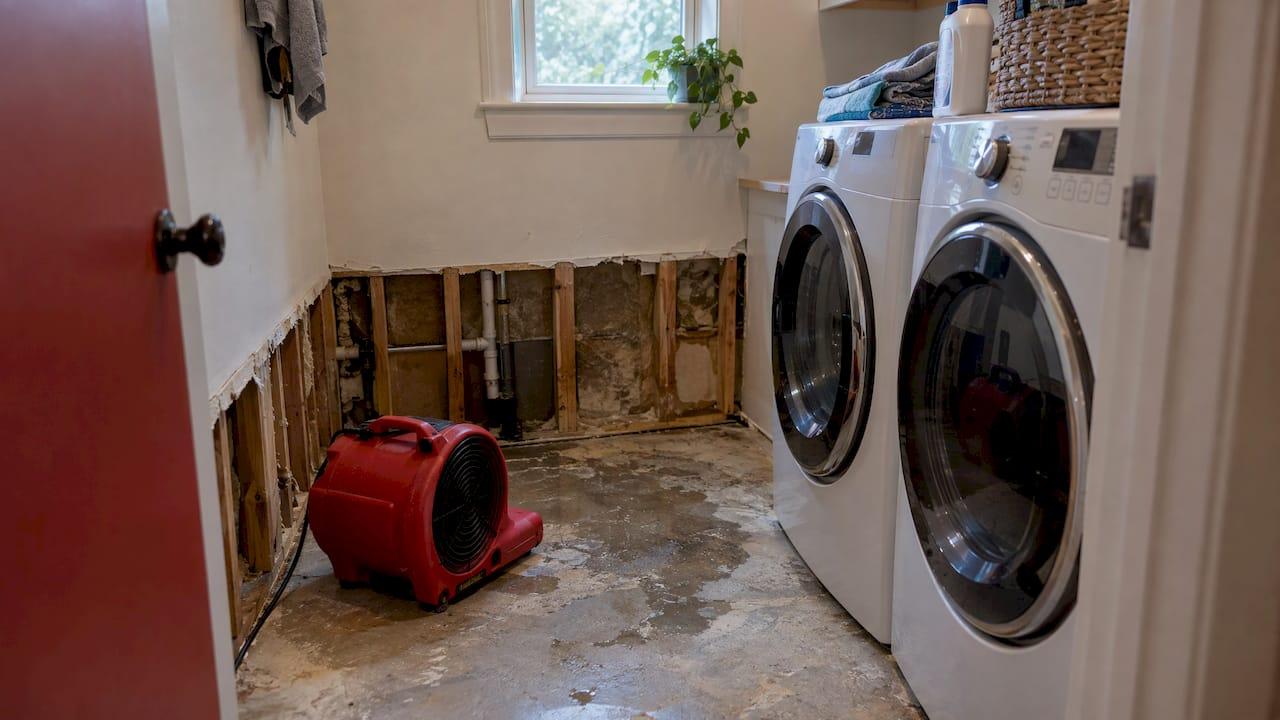
Water Damage Restoration Cost: What to Expect in 2026

Most published estimates put water damage restoration at roughly $1,300 to $7,000, with a national average between about $3,300 and $3,800. A small, contained leak can cost far less. A black water loss that reaches the structure can cost many times more. The number depends on three things: what kind of water it was, how far it spread, and how much has to be rebuilt afterward.
We are Ready 2 Inspect, a licensed mold and restoration company in Lake Mary, Florida. Below is how the pricing works, what drives it up, and how to avoid the mistakes that make a $3,000 problem into a $15,000 one.
TL;DR
- National estimates for restoration run about $1,300 to $7,000, with averages from roughly $3,300 (Forbes Home) to $3,800 (RestoreAdvisor).
- Extraction and drying (mitigation) is one bill. Rebuilding drywall, flooring and trim is a second bill, and it is often larger.
- Water that sits longer than 24 to 48 hours risks mold, which adds its own cost.
- Standard homeowners policies generally cover sudden events like a burst supply line, not flood. Call your insurer before you sign anything.
- In Florida, report a claim within one year of the loss. Do not wait to start drying.
Table of Contents
- What water damage restoration actually costs
- Mitigation and rebuild are two separate bills
- Cost per square foot
- What pushes the price up or down
- A realistic example
- What the first 24 hours should look like
- Does homeowners insurance cover it?
- Perspective: sequence matters more than speed
- How to compare water damage quotes
- Can you do any of it yourself?
- Water damage costs in Lake Mary and Central Florida
- Get a price in writing before work starts
- FAQ
- Sources
What water damage restoration actually costs
Published national figures vary by source, but they cluster in the same neighborhood:
| Source | Typical range | Average |
|---|---|---|
| Forbes Home (updated February 2025) | $1,300 to $5,600 | $3,300 |
| RestoreAdvisor (2026) | $1,500 to $7,000 | $3,800 |
The same sources show how wide the tails are. Forbes lists a low of $450 and a high of $13,000. RestoreAdvisor describes small contained incidents as low as $350 and severe black water losses above $20,000 once structural repair and contents are included.
Region matters too. A 2026 city index reports a 50-city average of $3,465, with the South averaging $3,330. Treat those as a sanity check, not a quote. Your own number depends on your house, and nobody can give you a real price without seeing it.
Mitigation and rebuild are two separate bills
This is where most surprises come from. Restoration has two phases:
- Mitigation. Stop the source, extract standing water, remove materials that cannot be saved, and dry the structure. RestoreAdvisor describes drying as typically taking 3 to 5 days.
- Repair and reconstruction. Replace what mitigation could not save: drywall, insulation, flooring, baseboards, cabinets, paint.
One published breakdown puts mitigation alone at about $1,383 to $6,384, with an average near $3,865, and notes that a $3,000 to $5,000 mitigation bill can grow into a total project of $15,000 to $25,000 or more once reconstruction is added. That is a worst-case pattern, not a typical one, but it shows why you should ask for both numbers up front.
When you collect estimates, ask each company a simple question: does this price include the rebuild, or only the drying? A low mitigation number from a company that does not rebuild only tells you half the cost.
Cost per square foot
Per-square-foot pricing is how most estimates get built, so it helps to know the ballparks.
Extraction and drying. RestoreAdvisor reports $3 to $7.50 per square foot for extraction and drying. A published roundup of Fixr and HomeAdvisor figures breaks extraction down by water type:
| Water type | Typical extraction cost per sq ft |
|---|---|
| Clean (Category 1) | $3.75 to $4.25 |
| Gray (Category 2) | $4.10 to $6.50 |
| Black (Category 3) | $7 to $7.50 |
Those figures come from this extraction cost summary, which also cites emergency fees of $50 to $200 on top. Treat them as published averages. Real jobs are priced by the room, the equipment days, and the materials removed.
Repair and rebuild. RestoreAdvisor puts repair work such as new drywall and flooring at an additional $20 to $37 per square foot. Flooring is the swing item. Carpet pad is cheap to replace. Hardwood, engineered wood, tile on a wet slab and cabinet toe-kicks are not. Material choice, not the water, often sets the final total.

What pushes the price up or down
The type of water
Water is sorted into three categories by how contaminated it is.
- Clean water comes from a broken supply line, a failed water heater or a leaking appliance supply. It is the cheapest to handle, but only for a short window.
- Gray water comes from a dishwasher, washing machine or a sink overflow. It carries some contamination.
- Black water includes sewage backups and flood water. Porous materials usually have to come out, and the labor is heavier.
Clean water does not stay clean. Left sitting, it degrades into a higher category, and the bill follows.
How long it sat
The single biggest controllable cost is time. RestoreAdvisor notes that materials wet for longer than 24 to 48 hours become prone to mold growth, and that mold remediation can add $1,200 to $3,800 or more on top of the repair. In Central Florida, where indoor humidity is already high for much of the year, we see a wet wall cavity turn into a mold job quickly. Starting extraction today is almost always cheaper than starting next week.

How far it spread
Water moves. A leak under a dishwasher can end up inside the wall, under the next room’s flooring and in the insulation above a ceiling. A moisture meter and thermal camera find what the eye cannot. A quote written without moisture readings is a guess.
What is in the way
Tile, built-in cabinets, stone counters and tight layouts add labor. So does a slab versus a raised floor, and a second story with a wet ceiling below it.
Emergency timing
Nights, weekends and holidays can carry emergency fees. The figure cited above is $50 to $200, though pricing varies by company.
A realistic example
Take a dishwasher supply line that fails overnight in a kitchen. Water spreads across about 150 square feet of tile and laminate and wicks up the drywall behind the cabinets.
At the published extraction and drying range of $3 to $7.50 per square foot, that room would land somewhere between $450 and $1,125 for the emergency phase alone. Cut out and replace a few feet of wet drywall and baseboard, replace the laminate, repaint, and the rebuild adds real money on top, because repair work is quoted separately and priced by material. This is arithmetic from published ranges, not a quote. The point is the shape: mitigation is the smaller number, and the rebuild decides the total.
What the first 24 hours should look like
- Stop the water. Shut off the supply valve or the main. If water is near outlets or the panel, stay out and call an electrician.
- Take photos and video of the damage, the source and any damaged belongings before moving anything.
- Call your insurer. Insurance regulators consistently advise prompt contact. Arizona’s insurance department advises contacting the insurer before a contractor, and confirming your deductible and coverage limits.
- Make temporary repairs only. The North Carolina Department of Insurance advises temporary repairs to prevent further damage, saving receipts and postponing permanent repairs until the insurer has inspected, where feasible.
- Start extraction and drying. Do not wait for the adjuster to start drying. Document first, then dry.
If a leak started in a bathroom, find out why it leaked before rebuilding. Shower pan and waterproofing failures are a common repeat cause, and a contractor can explain shower waterproofing methods and the 24-hour flood test so the same wall does not get wet twice.
Does homeowners insurance cover it?
Often, but the policy decides. A few points that regulators and published guidance agree on:
- Sudden events are generally covered. Arizona’s insurance department says non-flood water damage and mold remediation may be covered after a sudden or accidental event, but the policy controls. RestoreAdvisor gives the common example: a burst supply line is usually covered, while storm water entering from outside falls under a flood policy.
- Flood is separate. The North Carolina Department of Insurance states that standard homeowners policies do not cover flood or rising water, which is purchased through the National Flood Insurance Program.
- Check the details. Maryland’s insurance regulator tells homeowners to check limits for water damage, sewer and drain backup, sump-pump failure and additional living expenses. It also explains that actual cash value deducts depreciation, while replacement cost does not.
- Mind the clock in Florida. According to a Florida law firm’s summary of the statute, property owners must report a new claim within one year of the date of loss. Confirm the current rules with your insurer or the Florida Department of Financial Services.
Those are state-by-state sources, so read your own policy for the Florida specifics: your deductible, your coverage type and any water damage limits.
Perspective: sequence matters more than speed
Every company in this business will tell you how fast they can get to your house. Speed matters, because wet materials do not wait. But the thing that hurts homeowners most is not a slow truck. It is tearing out a wall before anyone has said who is paying for it.
That is why we work in a set order. We look at the damage, we put the cash price on the table before a claim is filed, and we lay out every outcome, including the one where insurance pays nothing. Work starts once you have decided. If you have no insurance, or you would rather pay out of pocket, we take that job too and put the price in writing first.
The second thing is the split between mitigation and rebuild. Many homeowners get a drying quote from one company, then discover they need a second contractor for the drywall, tile, cabinets and trim. We are licensed for the reconstruction as well, so the company that opens the wall is the one that closes it, and we manage the claim from start to finish. You deal with me directly, and I come out myself.
When you compare quotes, ask what is included, who does the rebuild, and who talks to the adjuster. Those answers explain most of the price difference.
John Foutz
How to compare water damage quotes
Two quotes for the same loss can be $2,000 apart and both be honest. The difference is usually scope. Compare these:
- Moisture readings. Does the estimate list readings and where they were taken?
- Water category. Is the water called clean, gray or black, and why?
- Equipment and days. How many dehumidifiers and air movers, for how many days?
- What gets removed. Which materials come out, and by how many feet?
- Rebuild. Is it included, priced separately, or left to you?
- Mold. What happens if drying fails or mold is already present?
- Insurance. Who handles the claim paperwork and communication with the adjuster?
- Licenses. Florida requires mold work to be done by licensed professionals. Ask for the license numbers and verify them.
Be wary of a drying quote that says nothing about the rebuild, and of any company that pushes you to sign over your claim before you have seen the price.
Can you do any of it yourself?
Yes, within limits. For a small clean water spill on a hard floor, mopping up, running fans and a dehumidifier, and checking nearby baseboards the next day is reasonable. Stay out of it and call a professional when:
- the water is gray or black water,
- it has been wet for more than a day or two,
- carpet pad, drywall or insulation is soaked,
- you see or smell mold, or
- it came from above and the ceiling is sagging.
If you see dark growth or a musty smell after a leak, our mold remediation page explains how assessment works. Anyone with asthma, allergies or a weakened immune system should leave heavy cleanup to professionals and speak with their doctor about symptoms.
Water damage costs in Lake Mary and Central Florida
Published figures put the South’s typical project average at $3,330, a bit under the national figure. Local cost depends less on the region than on the house. Central Florida homes are mostly built on slabs, so a leak often spreads across flooring and into the bottom of the walls rather than down into a crawlspace. Humidity means drying has to be done thoroughly, and an air conditioner running in a wet house can spread moisture and spores. Hurricane season and storm flooding add another layer: that is a flood insurance question, not a standard homeowners one.
We serve Lake Mary, Orlando, Longwood, Winter Springs and other cities across Seminole, Orange, Volusia and Lake counties.
Get a price in writing before work starts
We publish no flat prices for restoration, because every loss is different. What we do is look at the damage, take moisture readings, and give you the cash price before anything is filed or removed. Our water damage restoration work covers extraction, structural drying and the rebuild under one license, and we run the insurance claim end to end.

If you also see signs of mold, we offer a free mold inspection. You can reach John directly through Ready 2 Inspect. He answers the phone himself.
FAQ
How much does water damage restoration cost per square foot?
Published estimates put extraction and drying at about $3 to $7.50 per square foot, with the repair and rebuild adding roughly $20 to $37 per square foot on top. Clean water sits at the low end and black water at the high end. A written estimate after moisture readings is the only reliable number for your house.
Is water extraction included in the restoration price?
Usually yes. Extraction is the first step of mitigation, followed by drying and removal of materials that cannot be saved. Ask whether the rebuild is included too, because mitigation and repair are typically priced as separate phases.
Why is water damage restoration so expensive?
Because it is labor, equipment and rebuilding at once. Dehumidifiers and air movers run for days, wet materials must be removed and disposed of, and the repair can include drywall, flooring and paint. Waiting too long adds mold work, which can cost $1,200 to $3,800 or more.
Will homeowners insurance pay for water damage?
It may, if the cause was sudden and accidental, such as a burst pipe. Flood is typically excluded from standard policies, and the exact coverage depends on your policy and deductible. Call your insurer first and ask your adjuster to confirm the work is covered before it begins, as Arizona’s insurance department advises.
What if I do not have insurance or the claim is denied?
You still have options. We take cash-paying and uninsured jobs, and we put the price in writing before any work starts so you can decide with the full number in front of you.
Sources
- How Much Does Water Damage Restoration Cost? Forbes Home
- Water Damage Restoration Cost: $1,500 to $7,000 (2026), RestoreAdvisor
- Water Extraction: Equipment, Specs, Methods and Costs
- Water Mitigation Cost: Insurance, Mold, and DIY Tips
- Water Damage Restoration Cost Index: 50 U.S. Cities
- Water Damage, Arizona Department of Insurance
- After a Disaster brochure, North Carolina Department of Insurance
- An Insurance Preparedness Guide for Natural Disasters, Maryland Insurance Administration
- How Long to File a Property Insurance Claim in Florida
- Shower waterproofing methods and the 24-hour flood test