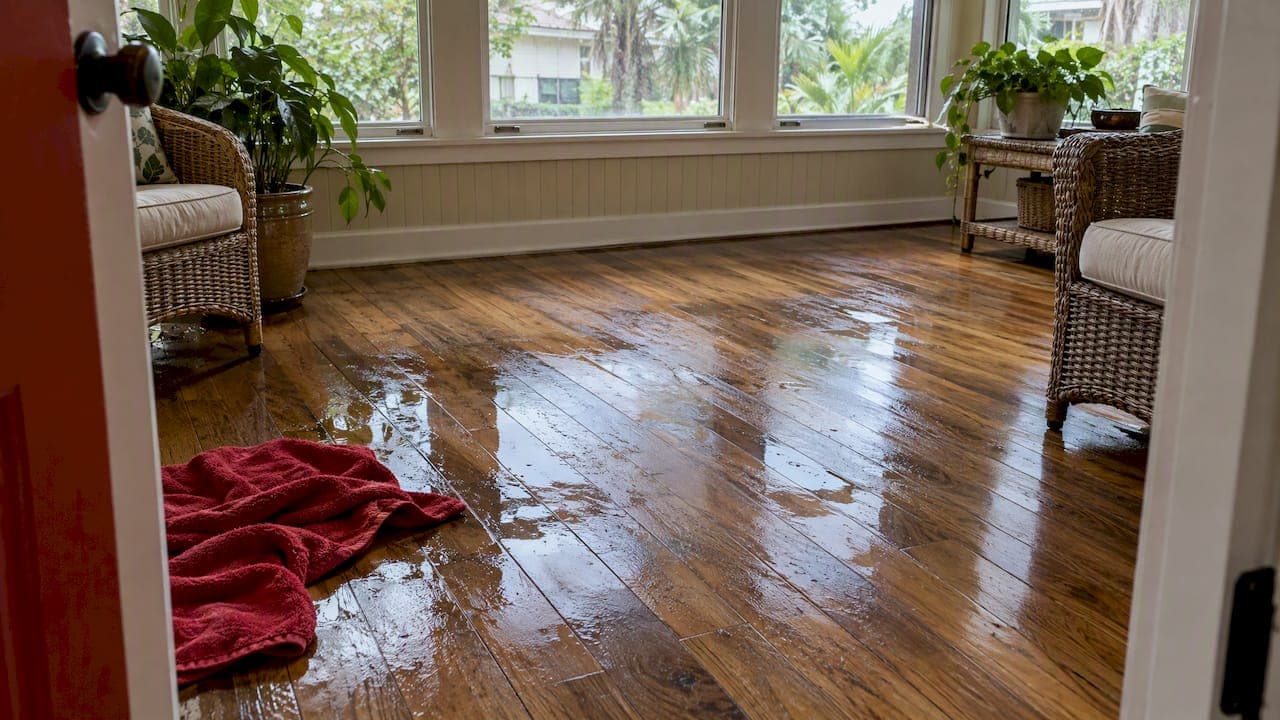
Wet Hardwood Floors: What to Do in the First 48 Hours

Stop the water, take out what you can, and start drying the floor and the space under it right away. Wood takes on moisture quickly, and the surface can look fine while the boards and subfloor underneath stay wet. Whether the floor goes back to normal depends on how long it stayed wet, how much water got in, and whether you dried below the boards as well as on top.
This guide walks through the first hours, how drying works, how to read the damage, and when it makes sense to stop and call someone. I’m John Foutz. I’m a licensed Florida mold assessor and remediator, and I came to restoration after nearly a decade as a Florida home inspector. I see wet floors that turned into mold jobs every month.
TL;DR
- Stop the source, remove standing water, and start drying. The EPA’s guidance is to dry clean-water damage within 24 to 48 hours to help prevent mold.
- Water under the boards is the bigger risk. Surface drying alone often leaves the subfloor wet.
- Do not run fans if the water might be contaminated (sewage, storm water, chemicals). That is a professional job.
- Do not sand or refinish until the wood and subfloor are fully dry. Slightly warped floors can sometimes settle back; badly buckled boards usually cannot.
- If you can’t dry it fast, or the area is large, call a licensed company before the wet cavity becomes a mold job.
Table of Contents
- The first hour: what to do right now
- Check what kind of water it is before you run fans
- How to dry wet hardwood floors
- Signs the water got into the wood
- Will the floor go back to normal?
- Why is my floor wet with no visible leak?
- Keep the floor from moving again
- Insurance: what to know before anything gets torn out
- Our perspective: sequence matters more than speed
- When to call a professional
- FAQ
- Sources
The first hour: what to do right now
Do these in order. Each step protects the wood from more water than it already took on.
- Stop the source. Shut off the supply valve, the water heater, or the dishwasher. If it’s a roof leak, tarp what you can and keep the room as dry as possible. The state of Massachusetts’ water damage response guidance starts the same way: identify and eliminate the water source first.
- Remove standing water. Use towels, a mop, or a wet vacuum. Move rugs, furniture legs, and anything sitting on the wood. Trapped moisture under a rug or a cabinet kickplate is a common reason a floor keeps failing after it looks dry.
- Pull up what can’t be dried. Wet area rugs, pads and cardboard go out. The same Massachusetts guidance says to remove wet porous items and examine wet materials promptly.
- Start moisture removal. Bring in a dehumidifier and, if the water was clean, fans moving air across the floor. We cover the details below.
- Take photos and notes. Photograph the source, the floor, and any damaged items before you move or throw away anything. You’ll need them if you file a claim.
Skip the wet mop and the steam mop on a floor that has taken on water. The National Wood Flooring Association’s homeowner handbook warns that wet and steam mops can damage the finish and the wood over time, and that spills should be wiped up right away with a dry or slightly damp cloth.
Check what kind of water it is before you run fans
This step decides everything else. Clean water from a broken supply line, a dishwasher hose, or a water heater is something you can start drying yourself. Water that came up through a drain, in from outside, or from a sewage backup is not.
The EPA says not to use fans until the water is determined to be clean or sanitary. Sewage, chemical, or biological contamination calls for protective equipment, containment, and experienced professional help, according to the EPA’s remediation guide. Fans spread contaminants through the house and into the air you breathe.
If you aren’t sure where the water came from, treat it as contaminated until someone qualified says otherwise. For a larger flood or any black-water event, Massachusetts’ guidance says to contact a professional flood cleanup or restoration contractor as soon as possible.

How to dry wet hardwood floors
The EPA’s guidance for wood surfaces that got clean water is to remove the moisture immediately and dry the material with dehumidifiers, gentle heat, and fans. It also cautions about using heat on hardwood floors. Emory University’s environmental health office adapted the same EPA guidance and repeats that caution.
What that means in practice:
- Dehumidifier first. It lowers the moisture in the room so the wood has somewhere to release water. Run it in a closed room.
- Fans across the surface. Aim air movement along the floor, not straight down at one spot.
- Gentle heat only. Hot air blasted at a hardwood floor can dry the top faster than the bottom and make the boards cup or crack. Keep it mild.
- Keep checking. A floor that feels dry to your hand can still hold moisture in the boards and the subfloor. Only a moisture meter tells you.
Water trapped under the boards
This is where most DIY drying fails. Water runs into the seams, under the planks and into the subfloor, and then it sits there. The EPA says the subfloor beneath flooring must also be cleaned and dried.
Professional crews have equipment homeowners usually don’t. A trade article in Restoration & Remediation Magazine describes floor-extraction mats: a sealed mat connected to an extractor that pulls moisture out from beneath the planks, run in 15 to 30 minute cycles depending on severity. The same article covers dehumidifiers, air movers across the floor, and negative-pressure drying systems for moisture between planks and below the surface.

You can’t improvise those with box fans. If water went under the boards, a licensed crew with moisture meters and the right gear is the best way to find out where the wet spots are and confirm that they’re dry.
How long does drying take?
There is no honest single number. Drying can take days, and a deep soak can take longer. The number people often hear is 48 hours, and it comes from the EPA. Its clean-water guidance is meant to be carried out within 24 to 48 hours to help prevent mold growth. The EPA also says that 48 hours is only a guideline and that mold can show up sooner or not at all.
So read it as a deadline to start and make real progress, not a promise that the floor will be dry by then. Here in Central Florida, where the air itself is humid, a wet cavity has a hard time drying without equipment pulling the moisture out.
Signs the water got into the wood
Look at the floor in daylight, then walk it. Common signs, drawn from RW Supply + Design’s water-damaged floors guide and local public health guidance:
- Wetness to the touch, or water seeping through the seams when you step
- Dark or discolored patches
- A blistered or peeling finish
- Loose or uneven boards, or areas that squeak or move
- Cupping (edges higher than the center), rippling, or buckling
- Delamination in engineered flooring
The Los Angeles County Department of Public Health also lists warped or cracked flooring, gradual rises, gaps in floorboards and a mold or mildew odor as signs to investigate for water damage.
A musty smell with no visible damage deserves attention too. It often means water is sitting under the floor, and that is the point where it can become a mold problem. If you see dark growth, or smell mold and can’t find it, a free mold inspection is a reasonable first step.
Will the floor go back to normal?
Sometimes. Wood naturally swells when humidity rises and shrinks when it drops. The NWFA’s homeowner handbook describes this as normal seasonal movement and recommends keeping indoor humidity around 30 to 50 percent and temperature between 60 and 80°F. Mild cupping from a short, quickly dried event can ease as the boards reach moisture balance with the room.
But there are limits:
| What you see | What it usually means | Typical next step |
|---|---|---|
| Slight cupping after a small, fast-dried spill | Boards took on moisture but dried | Monitor with a moisture meter; let the floor settle before any sanding |
| Cupping across a large area, boards still damp | Moisture trapped under the planks | Professional drying, then reassess |
| Buckling, boards lifting off the subfloor | Heavy saturation, possible subfloor damage | Remove affected boards, dry the subfloor, then repair |
| Black staining, musty odor | Water has sat long enough for mold | Mold assessment before any repair |
| Water from sewage or outside flooding | Contaminated | Professional cleanup; porous materials usually removed |
The University of Michigan’s environmental health guidance on repairing floors after water damage says floors should be assessed for repair, replacement, or recovery. It adds that badly warped hardwood usually can’t be repaired, and buckled or uneven sections should be removed and repaired.
Do not sand too early
The most expensive mistake I see is sanding a floor that only looks dry. If the top has dried and the underside hasn’t, sanding can flatten a cupped surface. When the bottom finally dries, the boards can crown and you’re left with a worse floor than before. Wait for readings, not appearance.
Before any new flooring goes in, the cause of the moisture has to be fixed and the subfloor moisture content has to be right. Bona’s repair guidance says the same about buckled boards that are too warped to save.
Why is my floor wet with no visible leak?
It happens more than people expect. Stanford’s environmental health library lists leaks, maintenance issues, HVAC problems, humidity, and condensation as common causes of water intrusion. In Florida homes, I look at these first:
- A slow supply line or an ice maker line behind a wall or cabinet
- A leaking water heater, dishwasher, or washing machine hose
- A clogged AC condensate drain line or a sweating air handler
- A slab or plumbing leak under the floor
- Roof or window leaks running down inside a wall
- Condensation from a house that runs warm and humid with cold supply air
If a floor stays damp or keeps cupping and you can’t find the source, don’t keep wiping. A licensed company can map moisture behind and under the flooring and trace it.
Keep the floor from moving again
Once the floor is dry, stable humidity is what keeps it flat. That’s the NWFA’s guidance, and it holds for any wood in the house. If you want to understand how humidity affects different wood and why the species alone won’t protect a floor, this look at how wood handles humidity is a good starting point.
For your own floors:
- Keep indoor relative humidity in the 30 to 50 percent range the NWFA recommends.
- Fix the AC drain line and check the air handler. A drain problem can dump water near a floor for months.
- Wipe spills at once with a dry or slightly damp cloth, and skip the steam mop.
- Put a small leak alarm near the water heater, dishwasher, and washing machine.
Insurance: what to know before anything gets torn out
Most people worry about the claim before they worry about the floor. Reasonable. Some water losses are covered, some aren’t, and the answer depends on your policy and the cause. A sudden burst line is treated very differently from a slow leak over months.
Here is the order I recommend:
- Stop the water and dry what must be dried now. Emergency drying to stop further damage is normal, and you should document it.
- Photograph everything before it’s moved.
- Find out who is paying before anything is demolished. That means your policy, the claim, and the cash price if the claim is denied.
- Decide, then start the work.
You can read more about how we run claims on our water damage restoration page.
Our perspective: sequence matters more than speed
Every restoration company will tell you they’re fast. Speed matters on a wet floor, because the clock on mold is real. But the thing that actually hurts homeowners is a crew that opens the floor first and sorts out who pays later. When the adjuster denies it, the homeowner is left with an open floor and a bill nobody explained.
So we work in a different order. Nothing comes out of your house until we all know who is paying for it. If you’re paying out of pocket, you get the price in writing before we touch anything, and we don’t quote cash customers out of the job. If you’re filing a claim, we lay out every outcome, including the one where insurance pays nothing. Work starts only after you decide.
We can also close the wall back up. We’re licensed for the reconstruction as well: drywall, tile, cabinets, counters, flooring, and trim. The company that opens the floor is the one that finishes it. I answer the phone and I come out myself. You’re not routed through a call center or a dispatcher.
On a wet hardwood floor, my advice is simple. If it’s a small, clean spill and you got to it fast, dry it and watch it. If water went under the boards, or it has been sitting more than a day or two, get a moisture reading before you decide anything.
— John Foutz
When to call a professional
The EPA says to seek professional help when the size of the affected area or your available resources make rapid, thorough drying difficult, or when contaminated water requires expertise. In plain terms, call if any of these are true:
- The water has been there more than a day or two
- It covers a room or more, or runs under cabinets or walls
- The floor is cupping, buckling, or the boards are lifting
- The water was dirty, or you don’t know where it came from
- You smell mold or see dark growth anywhere
- You don’t have a moisture meter and can’t confirm the subfloor is dry
If you’re in Lake Mary, Seminole, Orange, Volusia or Lake County, we can come out. Our water damage restoration team handles extraction and structural drying, and if mold has started, our mold remediation work is done by the same licensed company. Call us and you’ll reach John, not a dispatcher. You can also see our Lake Mary service page or start from ready2inspect.com.
FAQ
Can you fix hardwood floors that got wet?
Often, yes, if the water was clean and the floor was dried quickly and fully. Mild cupping can ease as the boards reach moisture balance with the room. Badly warped or buckled boards usually need to be removed and replaced, and the subfloor must be dry first.
How do I dry out wet hardwood floors?
Remove standing water, then run a dehumidifier and fans across the floor, using only gentle heat. Don’t use fans if the water might be contaminated. Water under the boards is hard to reach without extraction equipment, so a moisture meter and a professional assessment are the safe way to confirm the floor is dry.
Will a wet wood floor go back to normal?
It can, if the wet period was short and the moisture came out of both the boards and the subfloor. Wood swells and shrinks with humidity, and some movement settles on its own. Wait for the floor to dry completely before you decide on sanding or replacement.
Why is my floor wet but there’s no leak?
Common causes are a slow plumbing or appliance leak, an AC condensate line problem, humidity and condensation, or a roof or window leak running down a wall. If you can’t find the source, have a licensed company trace the moisture before you repair the floor.
Sources
- EPA: Mold Remediation in Schools and Commercial Buildings, Chapter 4
- Massachusetts: Quick reference, water damage response in buildings
- NWFA: Homeowner’s Handbook to Real Wood Floors
- Emory University: Response to clean water damage
- Restoration & Remediation Magazine: How to Dry Hardwood Floors in Water Mitigation
- RW Supply + Design: Water Damaged Floors Guide
- Los Angeles County Department of Public Health: Mold in the Home
- University of Michigan: Repairing Floors from Water Damage to Prevent Mold Growth
- Bona: Repair Buckled Hardwood Floors
- Stanford: Mold Prevention and Water Damage Response